

Cycle Sync Week 4 Reminders: Inner Fall Phase
Luteal phase Reminders and Priorities

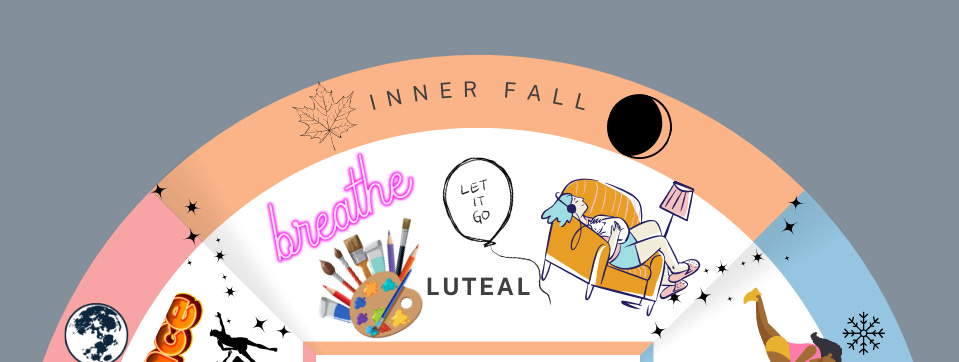
Inner Fall/luteal phase is notoriously the hardest phase for many women across the globe. At least 80% of all menstruating women experience at least one mood or physical pms symptom. 1
Week 4 of the menstrual cycle begins the inward pull. I don’t know how else to describe this over-arching energy except to say that it goes inward.
How do we know we have crossed over into inner Fall? Do you have tell tale signs?
5 signs of inner Fall
Feeling like you need to be alone
Needing more sleep
Irritable/sensitive to criticism
Everything takes so much longer/feeling of slowness
Decision making is hard, near impossible at times
Of course there are more signs than this. I have them and I bet you have them too. There are also physical signs and symptoms that some women experience in differing degrees.
Hormones Shape our Week 4, Fall Phase
Everything is shifting. Estrogen has just fallen sharply to release an egg at ovulation and then starts to rise moderately into the luteal phase. The egg sac that ruptured (corpus luteum) begins producing progesterone at 20 times the level of estrogen. This increase in progesterone has a calming effect and can make us feel lethargic and slow.

The luteal phase seems to have two parts-
Early Fall- rising estrogen and progesterone

Late Fall- falling estrogen and progesterone

If Week 4 of your menstrual cycle is a difficult time for you, it might be surprising to know that we have natural abilities that we can tap into which may even help to reduce some emotional, mental, and physical symptoms.
Natural Abilities
Saying “no”
Brainstorming energy
Problem-solving
Little or big “aha” moments
Organization skills
A natural critical eye on projects
Saying what no one else will
Creative energy
Creating healthy boundaries
Introspection
Letting go
Challenges
The challenges of inner Fall are also the natural abilities and the supportive ideas to try. Say what now? It’s true. Our societal pressures, our upbringing, or our internal pressures have all told us what we can’t and shouldn’t do. And yet, some of these are the abilities in this phase.
Saying “no” (this is our natural ability and also our greatest challenge)
Slowing down (it’s what our body is asking and also what we fight)
Creating boundaries (our ability and our challenge)
Letting go of expectations of yourself (ability and challenge)
Let go of expectations of others (ability and challenge)
Nuturing our basic needs (after two weeks of doing for others it can be a challenge to do this for ourselves)
Getting time alone (we need it for our social energy, emotional, mental, and physical energy, yet if we don’t know how to it can be uncomfortable)
Find a creative outlet (our ability and also our challenge if we think we aren’t creative)
Asking for help (delegating is a natural ability, but if we have been told it is a weakness to ask for help, this can be a challenge)
Supportive ideas to try
Block some time alone and ask for help to get it if needed
Make a reminder to hold boundaries when needed
Pull out a hobby you enjoy but haven’t done in a while
Practice saying “no” when the schedule fills up
Make space between events and tasks for brain breaks or cat naps— breathe
Organize a small space
Journal and brainstorm
Do any one of these ideas sound like something you want to try in your next inner Fall phase?

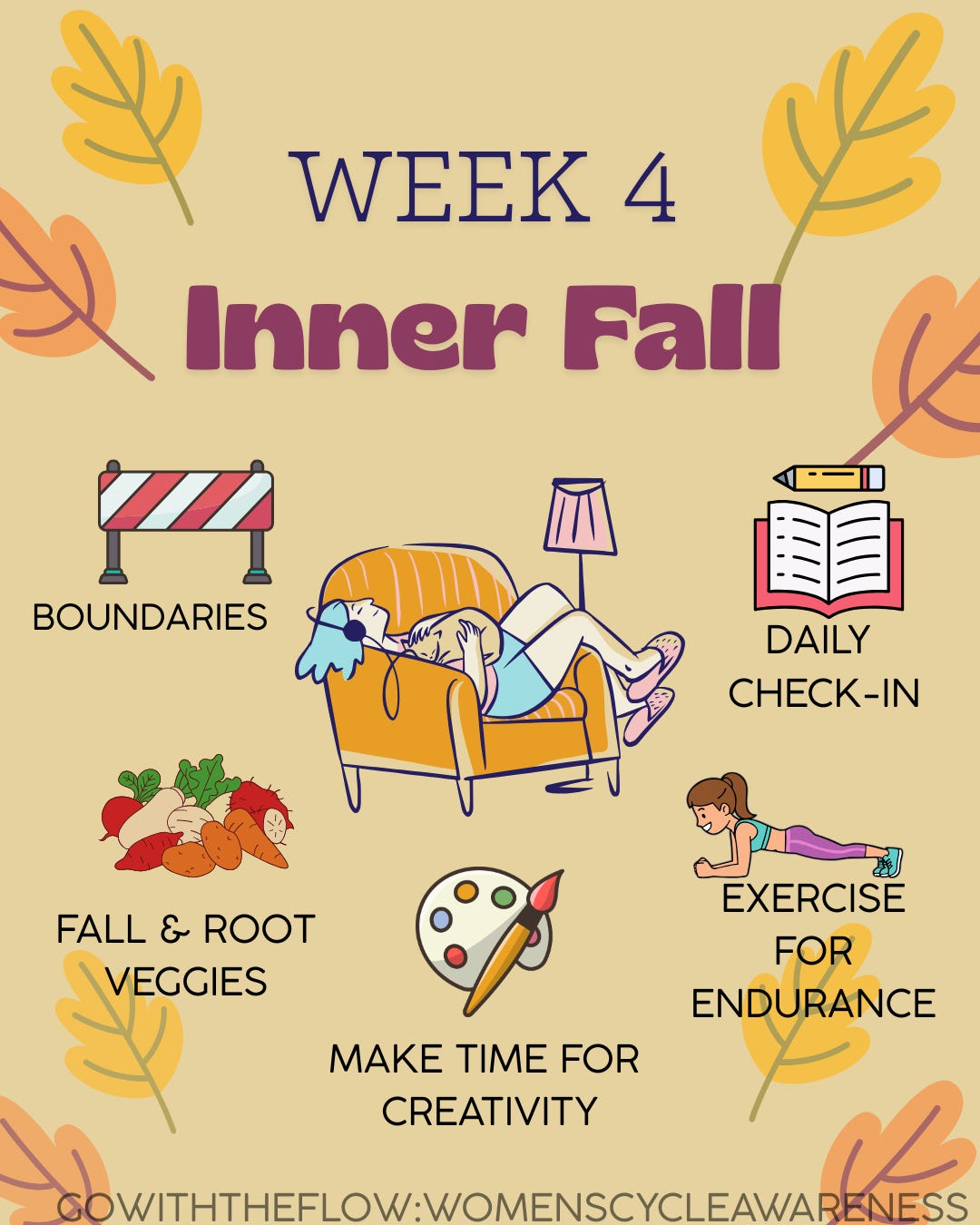
Cycle Syncing Priorities- Food, Movement, Downtime
Nutrition- focus on cruciferous veggies that move out estrogen, supporting progesterone, and support increased need for calories
🥦DIM- supports healthy estrogen metabolism. DIM is found in cruciferous veggies
brussels, asparagus, cabbage, broccoli, spinach, kale, chard, bok choy, cauliflower
🍠Complex carbs and fiber- supports blood sugar keeping energy up to produce necessary hormones. Many root veggies have vit B6, vital for mood, sleep, and menstrual balance
beans, lentils and quinoa
root veggies- potatoes, sweet potatoes, onions, garlic, beets(nitric oxide)
🥚Protein- supports blood sugar, uterine and ovarian tissue, energy production
eggs, fish, lamb, chicken
🥑Healthy fats and seed cycling- anti-inflammatory and supports menstrual cycle function.
avocado, olive oil, coconut oil
sunflower seeds and sesame seeds. *If you are seed cycling, sunflower and sesame in the second half of the cycle. lignans(phytoestrogens), zinc, and vit E.
🫐Anti-oxidants- supports healthy cellular function with vitamin C
citrus, pomegranates(nitric oxide building), apples, pears, blueberries
🌿Herbs- **ask your physician before adding any new herbs or supplements
dandelion root, milk thistle (supports the liver in metabolizing estrogen)
chamomile (supports progesterone production and aids in relaxation)
Movement- Endurance, Weights, Sweat
🚶🏽♀️➡️Endurance training- long hikes, swimming or long flat bike rides. Keeping the heart rate lower while you workout, reduces cortisol spikes6.
🏋🏼♀️Weights- Continue your weight routine. As you progress towards the end of inner Fall/week 4 you may need to adjust your weights and do less weight but more reps. Low and slow.
💦Sweat it out- Inflammation is higher in this phase5. Stretching, epsom salt baths, and sauna can help reduce inflammation. Also sweating helps eliminate excess estrogen.
PMS considerations:
General fatigue
Headaches
Bloating
Breast tenderness
Insomnia
Cramping
Brain fog
Mood swings
These are all pms symptoms that our body is communicating to us that maybe we need to turn our energy inward and tend to ourselves.
All of these symptoms can flare up or intensify if we are not listening to our needs, specifically, lower inflammation, focus on nutrition, movement, and rest.
Making downtime-
We know that reducing stress is something that we hear talked about all the time. Yet, it seems to be the hardest medical advice. It’s easy to say, “reduce your stress”. It’s hard to do. Why? Maybe because we believe that our busy lives can’t be changed. The constant go mode. The full schedules.
In order to reduce stress we need to re-evaluate where all of our energy is going. And not just where, but when. We feel the effects of stress more acutely during the 4th week and 1st week of our cycle.
Make a list of all of the places you put your energy. What are your life demands? Responsibilities? Commitments?
What we find is that many of these are things we have said yes to. And when that pile of yeses adds up and there are no spots for no’s, we are headed towards burnout or at the very least, more intense pms symptoms.
Downtime isn’t a luxury, it’s a medical necessity. Time alone or gaps in the schedule isn’t selfish, it’s a need just like food, water, and shelter.
Our nervous systems are always on. Can you prioritize calendar blocking to create space for yourself?

Setting ourselves up for the next phase
What we do in this phase sets us up for our next phase- Inner Winter/week 1. If we can learn to put on the brakes before we are completely melting down, not only do we honor our cycle, but we can reduce our emotional, physical, social, and mental premenstrual symptoms.
⬇️More about late luteal days leading up to menstruation in this podcast.

Notes to take with you:
Week 4/inner Fall/luteal phase is a time to pull inward, create healthy boundaries, slow down, and allow creative energy to flow.
Our natural abilities can also be our challenges as we go head to head with what we need versus what we think we are supposed to do in our society.
Practice saying “no”, creating space, journaling and brainstorming, and finding time alone.
Nutrition priorities this week are foods that support energy, estrogen metabolism, and reduce inflammation.
Movement priorities are endurance, weight training, and sweating.
One of the hardest but most important priorities is making time alone to support the nervous system.
❓❓What do you prioritize in your Week 4/Inner Fall?
Go With The Flow,

https://link.springer.com/article/10.1007/s00737-022-01261-5